Showing posts with label language. Show all posts

Tuesday, March 13, 2012

Nothing But Time: Exploring in C

Originally written in early February


Half Recovered Photo of Buddhist Monks


This is a bit of a tangent essay.

Just a few short hours after deleting my vacation photos, I wrote on here, as well as on facebook, bemoaning my stupidity.  Well, on facebook several friends were kind enough to point me to PhotoRec, a freeware program that recovers your lost photos.  I will not get into the specifics of how it works.  But after I got back, I downloaded the tar file for it.  Unfortunately Archive Utility would not unarchive it.  I would keep getting told “Error 2- no such file or directory.”  The best thing about freeware is that you can fiddle with it yourself.  The worst thing is that if you don't usually fiddle around with your computer, you can be more than lost with no customer service.
I would say my computer literacy is maybe a little bit better than my Chinese, though not as good as my Japanese.  That is to say, I've done some cool things in conjunction with classes where teachers would do the hardest parts and I could always double check to make sure I was doing the right thing.  It's been over six months since I've done any kind of programing, and I've forgotten the syntax for C.  I don't remember how list the files in a directory, but I know how to get to understand the contents of the help manual.  So right now I am spelunking through C, trying to see if I can unpack my tar file.  I know I have done all of this before once, but only once.
I will say, one of the great things about liberal arts is that you have the chance to try some crazy things unrelated to your major.  My last semester I took a class on data compilation for Physicists which involved learning the basics of C (a language not too different from Java, which I studied in high school, one of the basic languages many people start out learning).  C is a little bit less pretty and user friendly, and unlike Java, I don't think it can quite flow in a way that English speaking brains can intuit.  But it works.
I've found that I don't have the motivation to learn programing as an end to itself – I have to have some sort of goal, something I want to make.  Similarly, I don't think I would have the patience to learn a dead language – something that can't communicate with live people.  I admire people who can, I just don't think I could do that myself.
When I stop worrying about how much I've forgotten, and what a newbie I feel like, I learn quite a bit.
Though at times it can feel like you are just bashing your head against the wall.  Would that be .bash?

Saturday, February 18, 2012

A Force for Evil

This is just looking at a pair of characters and how character simplification works.  In spite of the ominous title, I don't have any philosophical story, or even anecdote around this theme.  I just think this is fun.
There are three sets of 'Chinese characters' 汉语、漢字used in the world today, Traditional 繁体字, Simplified 简体字, and Japanese Kanji (日本語の)漢字.  All three are based on the same set of characters.  Traditional characters have remained unchanged.  Though what words are used most often have changed, the way of writing words is no different.  Think of it like the difference between Dickens and Rowling.  Words have taken on new meanings, but the spelling is more or less the same.  Kanji underwent slow changes over a thousand years, and a few new characters were invented.  Then after World War II, the Japanese education system was reformed, standardized, and a number of characters were simplified.  Mainland China also simplified its character system.  In order to explain further how they were simplified, I would have to get into what makes a character and how do you read them, which I feel should be in another post.
One of the main things I've noticed, coming from Japanese to Chinese, is that most characters in Japanese fit into one set or the other – they are either the same as simplified or the same as traditional.  I found it interesting that one character, the character for evil, has turned out different in all three.

Traditional  繁体字
Japanese  漢字
Simplified  简体字

On the other hand, the character for demon/magic (usually appearing as a pair with the word 'evil') is the same in all three.

(, ,

Same combination, three ways of writing.  One changes, the other stays the same.
I guess the devil is in the details.

Sunday, October 30, 2011

Like Riding A Bike


This Friday I got a bicycle!  I haven't ridden since I was in middle school, but I got one for 130 yuan with a lock thrown in.  I should say, I picked the bike, and then Ruth and Jane (you may remember an earlier post talking about some girls who gave me moon cakes and some hand made flowers.  That was Ruth and Jane) bargained it down.  It has a white rose on it, which I did not see before I bought it, so I want to call it 薔薇 which means rose in Japanese.
(A side note about the word  薔薇.  My Japanese is not as sharp as it once was, so I checked to make sure that I remembered it correctly.  I did.  But I also discovered that there are two ways of saying  薔薇 which I was unaware of, which also mean rose.  The first, the one I knew, was 'bara' ばら.  The second and third, 'soubi' and 'shoubi' うび としょうび are written using the exact same characters.  About a week ago I was listening to someone explain to the foreigners who speak better Chinese why they think foreigners have a hard time reading since some characters have more than one way to be read.  Ha!  I say, ha!)
Yesterday I rode my new bike around campus, especially up and down the street behind our apartments next to the track field, which has little to no traffic.  Today I rode it to the convenience store on campus and to the soccer field.  I am still too scared to ride out in street traffic, but it is amazing how those fundamentals, once learned, stay in your brain.
I have managed to have an actual conversation with Mrs. Wang王太太.  In the International Affairs building right next to our apartments live Mr. Wang 老王 and his wife.  They are caretakers of the area and live in the International Affairs building.  Mr. Wang has a strong accent and even our Chinese friends have trouble understanding him.  Mrs. Wang on the other hand speaks very clearly.  Usually I can follow a conversation she has with someone else who speaks better Chinese, but can't actually say anything of consequence myself.  Well, today she was out gardening when I came out to ride my bike, and told her that I bought it yesterday, that it was not new, and that Molly had also gotten a not new bike yesterday.  Mrs. Wang knows a fair amount about bikes, and she said many things I did not catch.  She pointed out parts of the bike, possibly commenting on the quality.  But I was just so happy I could be understood saying small talk and could understand her as much as I did.  It's shaky, but it's just like riding a bike.

Friday, September 2, 2011

Piece of Cake (bing2)


This first week, I would like to highlight the word bing, which means 'cake'.  There are three cakes in particular I would like to highlight.
The first would be what we've had for breakfast most morning, da4bing2.  Da4bing2 is like a pancake, except occasionally it's filled with vegetables.  I myself have particularly liked the ones with just a little bit of green onion in the batter.  Each da4bing2 at the stall we frequent is about 8 inches in diameter, and costs 2 kuai (about 33 cents).  You can also just get half of one for 1 kuai, which is usually enough for me.  The street we eat at, (which William and the other exchange students two years ago dubbed 'breakfast street,' though they only sell breakfast at that corner) has a number of stores and businesses, but even more stalls.  People sell fruits and vegetables out of carts, bubble tea out of holes in the wall, drinks out of refrigerating units that don't fit inside their tiny stores packed with bottles of water, soda, and tea.  The place we buy da4bing2 has short tables and stools laid out next to the street.  The street itself has barely any room for cars, but cars and even trucks will still slowly make their way amidst the bicycles, rickshaws, open back rickshaws (like an open back truck, except with a motorcycle at the front), and people.  Occasionally I have seen some chickens in the alleys between the buildings, and there have been a few dogs.  If you go south along that street, the food carts are replaced by vendors selling used books laid out on the sidewalk.  If you go north, you find stalls selling mostly clothing and bedding, but we also found pots and pans and pirated dvds.

The second bing2 would be yue4bing2, or 'moon cake'.  Yue4bing2 are particularly important for mid-autumn festival, but stores are selling them now.  While we explored Kaifeng and Anhui (a city about three hours away from Kaifeng) Daniel pointed out to us some giant yue4bing2 about the size of a dinner plate, each decorated elaboratly or with the charater (fortune) which means fortune written on them.  I purchased a yue4bing2 from a stand in Anhui.  The two evenings we spent in Anhui we walked down a street not unlike Breakfast street, except even more crowded.  There were clothes stores, and ladies' undergarment stores with western looking manaquines, and puppies being sold in cages.  I bought a red bean paste moon cake, which I ate while everyone else was eating soft serve ice cream from KFC.

The third bing2 would be from Daniel Youd's last night in Kaifeng.  Daniel already knows the area, and is fluent in Chinese, so we never had pick random things from menus, we never had to try and pick our way through a conversation without having someone to translate.  He encourages all of us, even those of us who aren't students anymore, to reach out on our own.  But it was nice to have a safety net.  Also, Daniel has stories ranging from famous Armenians, to his daughter crochetting, to awkward situations as an exchange student in China in the early 90's.  We went to KTV (karaoke) the last night, which was unforgettable.  But before KTV, we ate Peking duck.  Peking duck a little bit like tacos.  The duck is served on its own, and in smaller dishes there might be small pieces of vegetables and a small bowel of sauce.  Everything is put together on a thin round piece of bread that looks a lot like a tortilla, called a bing2.


(Also, a few more photos)

Another Shot of Millenium Park

The rock reads has the Chinese name for Millenium Park.  The charaters read,  "Clear bright above the yellow river park"

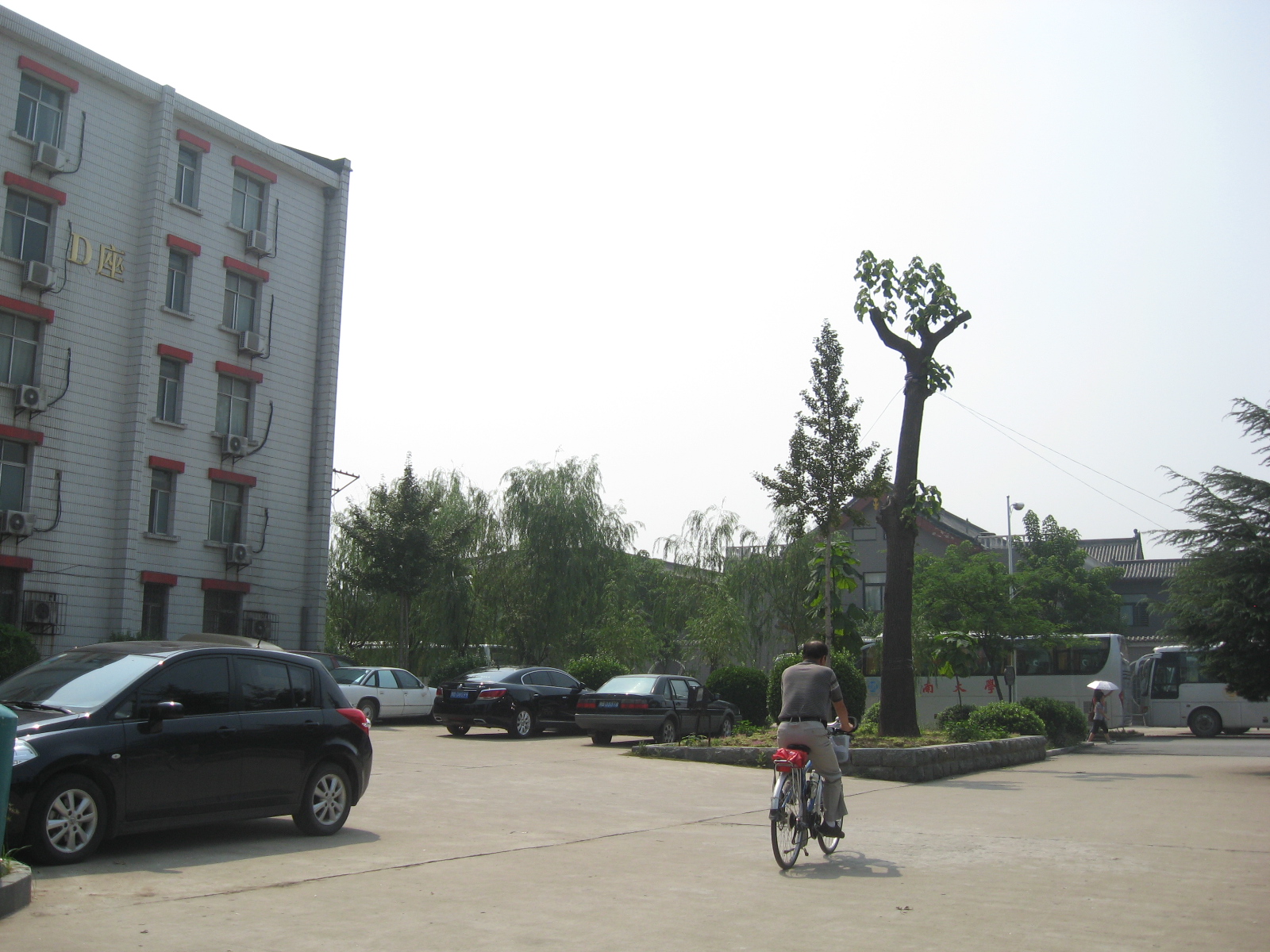
Henan University Campus.  On the left are the exchange student dorms.

Behind the fences are our dorms.

Iron Pagoda Park 
This was taken in the Shanghai airport.  I would recommend you zoom in and look at the sign (there's an English translation under the Chinese).

Friday, July 15, 2011

A Bad Feeling

After a certain point when living abroad, most people have a moment when they realize they are thinking in a foreign language.  I'm not sure if the period of time is different for different languages (a friend's dad told me he was dreaming in Spanish after living in a home stay for two weeks), but on average after about three or four months it kicks in.  Your brain re-sets.  Unfortunately it's not a complete process.  You still make lots of mistakes in the language your learning, though you're getting better.  The biggest thing you'll notice is that now you can communicate in English about as well as you can communicate in your second language.  Your English become broken, grammar is forgotten or morphed to fit the second language.  Every day words will escape you.  And the damage is permanent - you will never get back to the same comfort you had with English before you had the brilliant idea of acquiring a second language.

The only people you will be able to have a full conversation with at this point will be your fellow language students.  If they can also think half in English and half in your other language, you'll be set!  Over time, more and more words will be part of your second language.  By the time you go home, words like, 'See you!' or 'Wait a second' will feel strange and awkward in your mouth for a few weeks.

Ever since I got home from Japan, I was very curious to find out what Japanese phrases were going to stick to me the longest.  What would be the hardest to get used to saying in English.  Your native language is your native language.  It doesn't take too long to acquire it back and begin thinking full time in English.  But I have a winner - a word that doesn't have a good direct translation in English.

きもい kimoi (to have a bad feeling)

きもい (kimoi) is really a contraction of two words that form a very common phrase, 気持ち悪い (kimochi warui).  Literally, is means 'feeling bad' or 'to have the feeling that is bad'.  But this is the simple explanation.  There are all sorts of phrases in English that we use instead the capture a portion,  but not the essence of 気持ち悪い (kimochi warui).  When you see a bug on the sidewalk, and say, 'that's gross!' in Japanese, you say, '気持ち悪い (kimochi warui).'  When you see a dark alley way, and say, 'that looks creepy,' in Japanese, you say, '気持ち悪い (kimochi warui).'  If you're watching a horror movie and the monster is about to brutally murder someone, and say, 'no!  I can't watch this anymore!' in Japanese, you say, '気持ち悪い (kimochi warui).'  To really get the proper sense of 気持ち悪い (kimochi warui), I want you to imagine a black, slimy bug with long tentacles that slithers along the ground.  Now imagine that it is crawling around inside of you.  You now have the true sense of 気持ち悪い (kimochi warui).  But 気持ち悪い (kimochi warui) takes too long to say.  That bug could crawl out of you before you finish speaking.  That is きもい (kimoi).

I have yet to find a phrase in English that has that same flavor of internal disgust.  It is being grossed out not by what you see or observe, but by something that manages to touch your soul.  Of all the many things I absorbed from Japanese, the apologizing, the round about questions, all of these things I have been able to easily turn into English mannerisms.  But nothing in the English verbal imagination can take the place of  きもい (kimoi).

Monday, June 6, 2011

Apples and Oranges

        This past weekend I decided to exercise my mind a bit and review some vocabulary.  I have been regularly reviewing Chinese, but this time I decided to use several DS games that are supposed to build vocabulary, 大人の漢字練習 (a Japanese game for practicing characters), and My Spanish Coach.  I was dismayed to learn my faulty memory in both games and languages.  While my only formal exposure to Spanish was through a series of teachers in high school whom I can now safely say were the most uninspiring teachers of all my years of schooling, I have spent the better part of my college career trying to learn Japanese.
      I have heard that Japanese in one of the hardest languages for English speakers to learn.  And, I have been practicing my characters less than diligently this last month.  In the past two weeks, my Japanese practice has consisted of watching a Japanese movie with subtitles.  At one time, I could confidently say that I knew the readings of 600 kanji (Chinese characters used in Japanese).  Then I remember that I was told that learning 1000 characters, my goal last fall semester, 'isn't all that hard.'  I will not say who it was, but it was someone who's primary focus is Chinese.
      One of the easiest ways for Chinese and Japanese learners to measure their progress is by the number of characters they've learned.  In Chinese, everything is written entirely with characters.  The number of characters one learns corresponds closely with the number of vocabulary words learned.  Japanese, on the other hand, has two phonetic alphabets.  Though most words can be written in characters, the number of characters taught in class represent a fraction of the total vocabulary.  I think some Japanese learners (myself at least) can feel defensive when comparing themselves to Chinese learners.  But the nature of the languages is different.  In Chinese, a sizable minority of characters have two possible pronunciation.  In Japanese, every character has at least two possible readings; more common characters have three or four or five.  The following is one of my favorite examples to demonstrate this:
                                                                                美月
                                                                                mi(gatsu)
美人
                                                                              bi(jin)
美                 美い
   mei3                                                               uma(i)
美しい
                                                                             utsuku(shii)
美味しい
                                                                             o(ishii)

One of the things that kept happening in my review this weekend, would be that I'd remember one or two readings, but not the correct one for the example the review program gave me.
     On top of that, grammar is completely different in both languages.  A lot of people are intimidated by pronunciation in Chinese.  I believe that, though hit is not tonal, Japanese is structurally more difficult for English speakers to think in.  Let me give another example from first year Chinese/Japanese respectively.  Let's say you want to say the simple sentence, 'I eat rice.'

               我  吃  飯。                                
                I   eat  rice.                                     
               
               私            は              ご飯             を             食べます。
                I   subject marker      rice    object marker         eat.

Now, let's say, 'I ate rice yesterday.'

               我    昨天        吃  飯。              
                I  yesterday    eat  rice.                

              私      は               昨日       ご飯        を        食べました。
               I   sub.marker   yesterday   rice    obj. marker         ate.

You can see, even if you don't read Japanese or Chinese, the differences in sentence structure.  You can also compare visually the sentences.  You can see, for example, when present tense becomes past tense the end of the verb changes in Japanese, but does not in Chinese.  Don't get me wrong.  Chinese does have grammar, and it is very difficult for English speakers to learn.  But even though after three years of study the Japanese learner knows several hundred fewer characters than their counterparts in Chinese, the Japanese learner knows more than a few things the Chinese learner doesn't.